Ceremonial Staffs
Africa
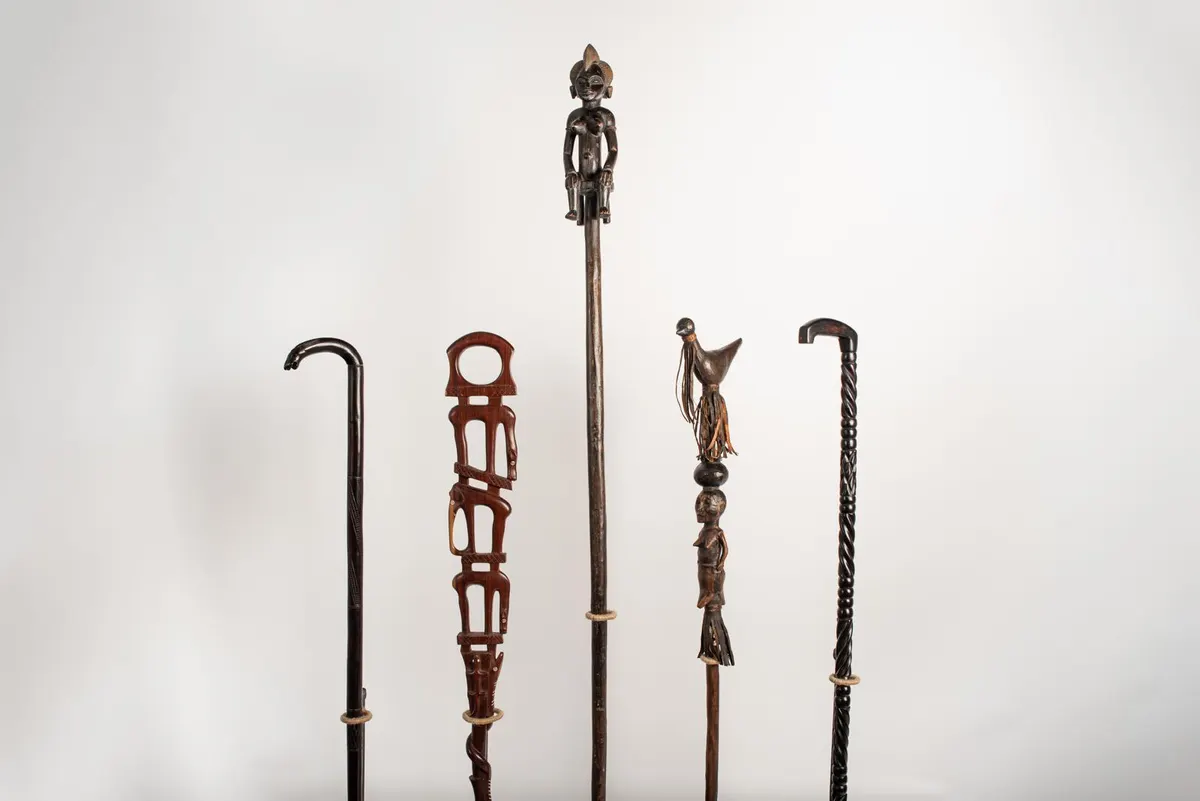
A grouped ensemble of five ceremonial staffs constructed along vertical axes, each organised through a continuous shaft terminating in a sculptural finial or handle form.
Description
The first staff is carved in ebony, the shaft carrying incised diagonal lattice motifs and terminating in a hook handle with a carved animal head at the terminus, species unconfirmed. The second staff is carved in hardwood, organised through alternating crosshatch bands and vertical openwork bar segments, terminating in a pierced oval loop handle; three carved heads are positioned in profile along the shaft — horse, elephant, and horse in descending register — each fitted with an inlaid eye; serpent and lizard forms are carved near the base of the openwork section; a dark panel bearing an incised letter B is positioned beside the lowermost head; the shaft transitions below into a spiral-twisted lower section. The third staff, Senufo, is organised through a continuous attenuated shaft terminating in a seated female figure finial; the figure is seated on a four-legged stool carved as a continuous extension of the finial, weight-bearing through buttocks and thighs; the coiffure rises in a crested, fan-form projection; raised linear registers are carved across the shoulders, torso, and limbs. The fourth staff is a composite construction: a standing wood figure, weight-bearing through legs and feet, its coiffure carrying a raised element, surmounted by a wood bead separating the figure from a leather-clad bird form carried above the figure’s head; a chevron-patterned wrapped collar with fringe sits below the bird; a second fringe band marks the base of the figure before the transition to the plain lower shaft. The fifth staff is carved in ebony, the shaft turned in a repeating pattern of spiral and bead segments, terminating in a curved cane handle.
Surface is compact and stable across the group. Exposure is located at handle contact points and at projecting carved elements. Patina is retained within incised and openwork zones. Leather is retained at the bird crown and collar of the fourth staff, with reduction at the fringe edges.
Context
Ceremonial staffs of this type function across multiple African societies as supports of status, authority, procession, elderhood, and ceremonial identity.
Provenance
From the Felice Maffei Collection, acquired between 1971 and 1987.
Details
- Title
- Ceremonial Staffs
- Origin
- Africa
- Date
- 20th century
- Dimensions
- Five staffs · Heights: 92 cm (36.2 in), 94 cm (37 in), 140 cm (55.1 in), 97 cm (38.2 in), 97 cm (38.2 in)
- Medium
- Wood, ebony, hardwood, and leather
- Provenance
- From the Felice Maffei Collection, acquired between 1971 and 1987.
- Condition
- Stable surface; handling wear consistent across the group.