Ashanti Kente Textile
Ghana
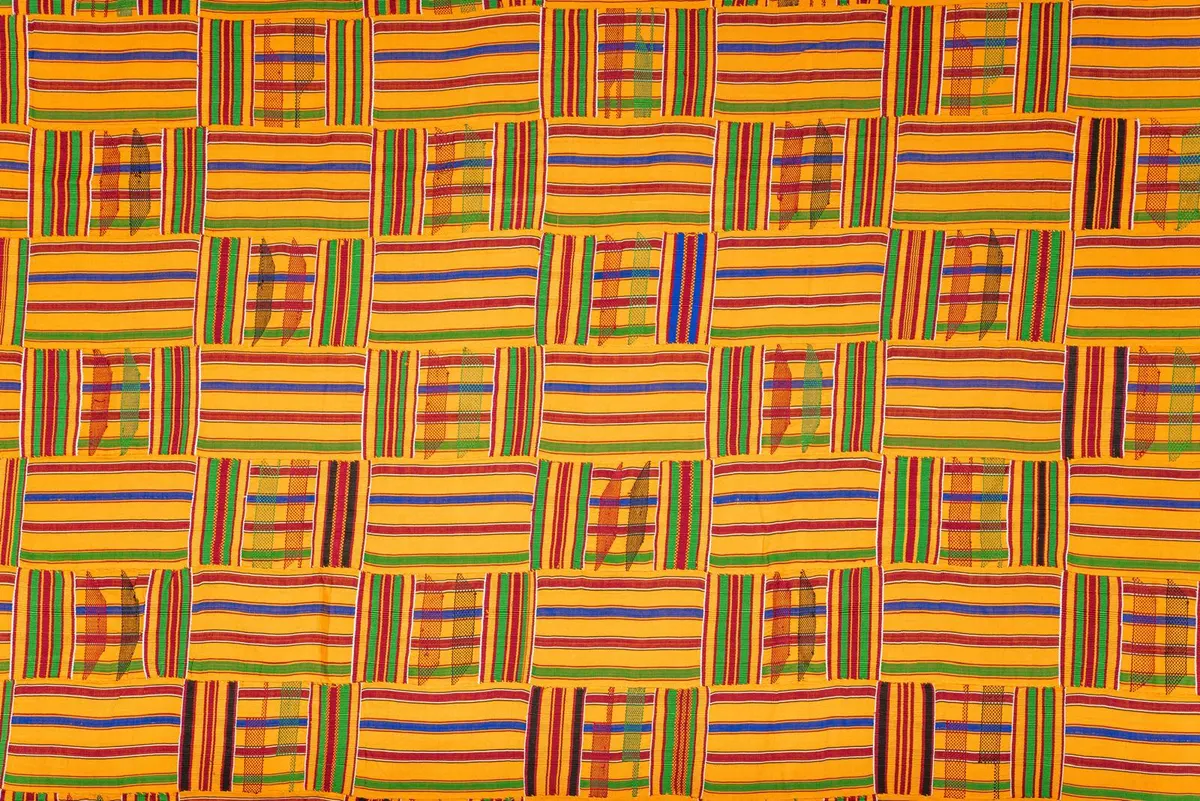
A planar textile field organised through segmented vertical registers and alternating woven bands.
Description
The textile is constructed from twenty-three narrow loom-woven cotton strip units joined through continuous longitudinal seams to produce an extended rectangular field. Adjacent strip units alternate between a vertical-striped orientation and a horizontal-banded orientation, establishing the field’s primary structural rhythm. Rectangular woven inset panels incorporating open lattice-patterned weave transitions interrupt selected strips at measured intervals, producing shifts between open linear fields and compact patterned compression while continuity is preserved across the textile surface. The organisation remains modular, with each woven strip retaining slight structural variation within the larger unified field. The lower edge terminates in a continuous woven fringe formed from the strip ends.
Surface is compact and stable throughout the textile. Colour retention remains stable across the woven field. Structural continuity across the joined panels remains intact.
Context
Kente textiles of this type functioned within ceremonial and royal systems of display, where narrow-strip weaving allowed expansion into large-scale wearable and architectural textile forms.
Provenance
From the Felice Maffei Collection, acquired in Ghana, 1964.
Details
- Title
- Ashanti Kente Textile
- Culture
- Ashanti
- Origin
- Ghana
- Date
- Mid-20th century
- Dimensions
- H 337 cm (132.7 in) · W 234 cm (92.1 in)
- Medium
- Cotton
- Provenance
- From the Felice Maffei Collection, acquired in Ghana, 1964.
- Condition
- Stable surface; colour retained; seam transitions intact.