
Safavid and Qajar Persian art
Six works from Iran in the Felice Maffei Collection, all acquired in Iran in 1968. Three are Safavid engraved copper of the 17th century, two are 19th-century engraved copper from Isfahan, and one is a Qajar lacquer mirror case.
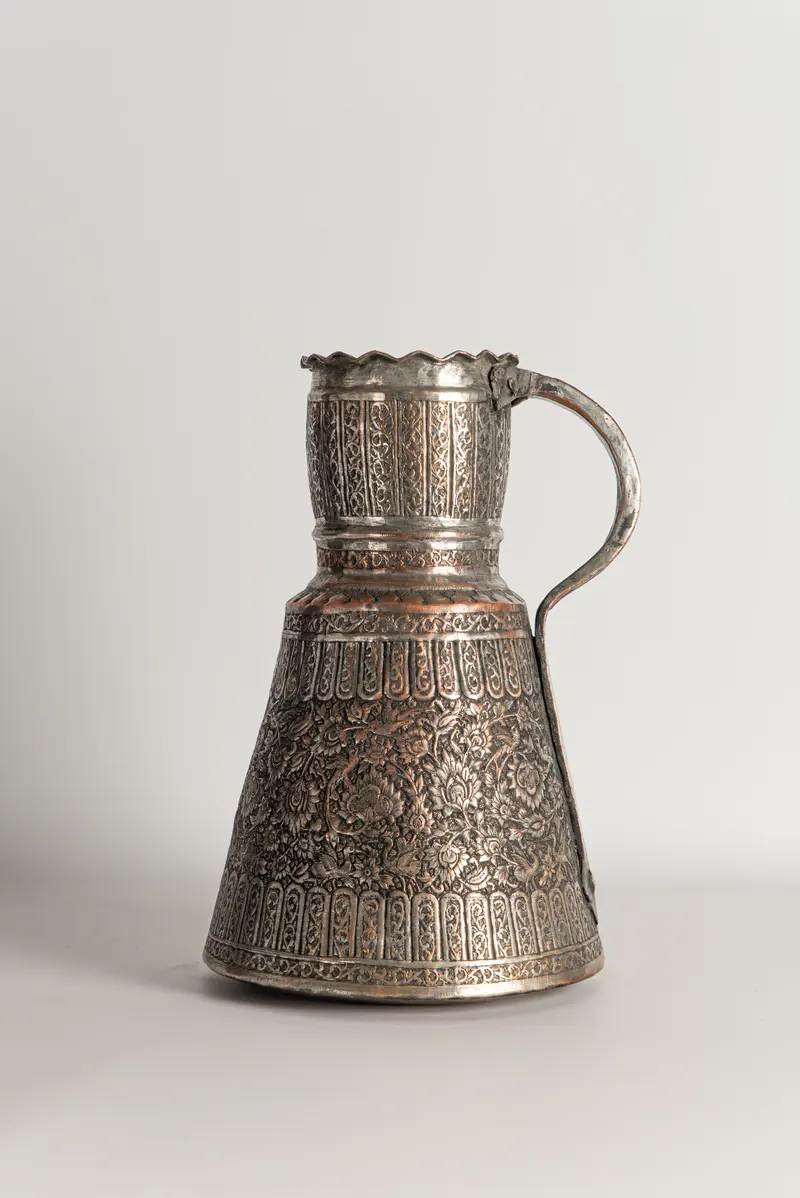
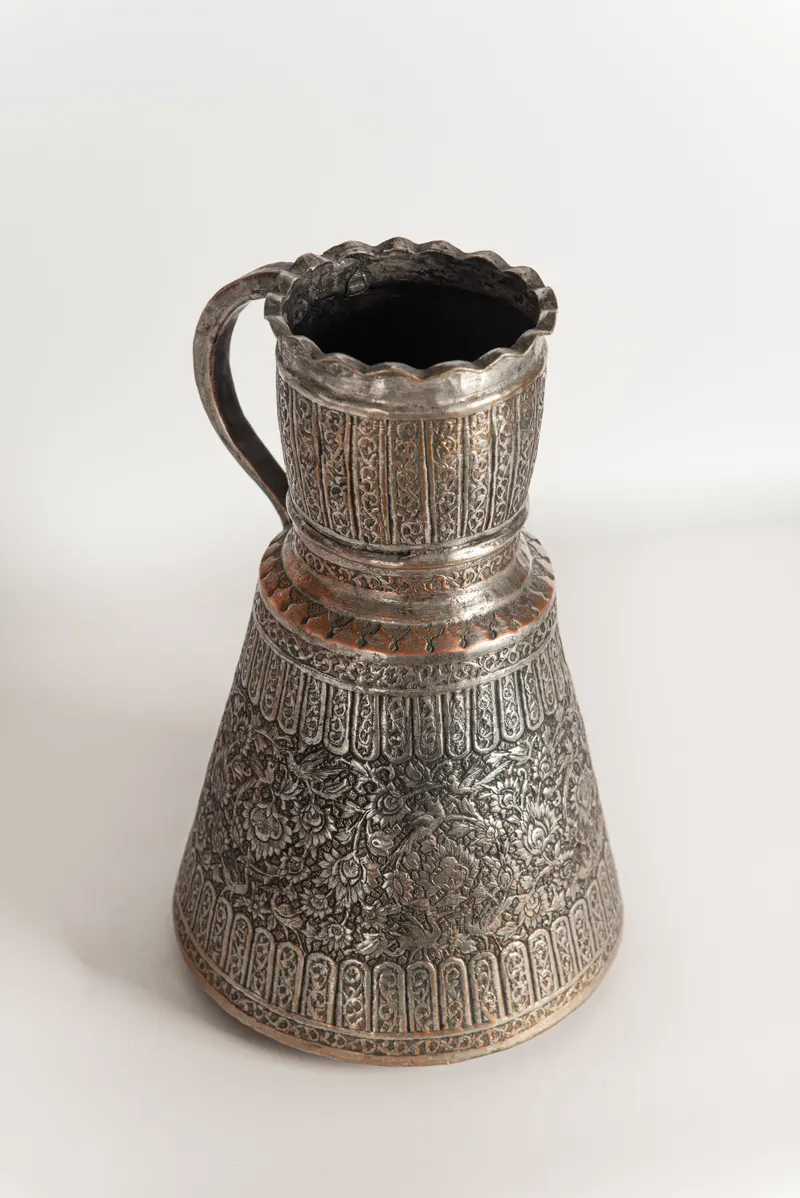
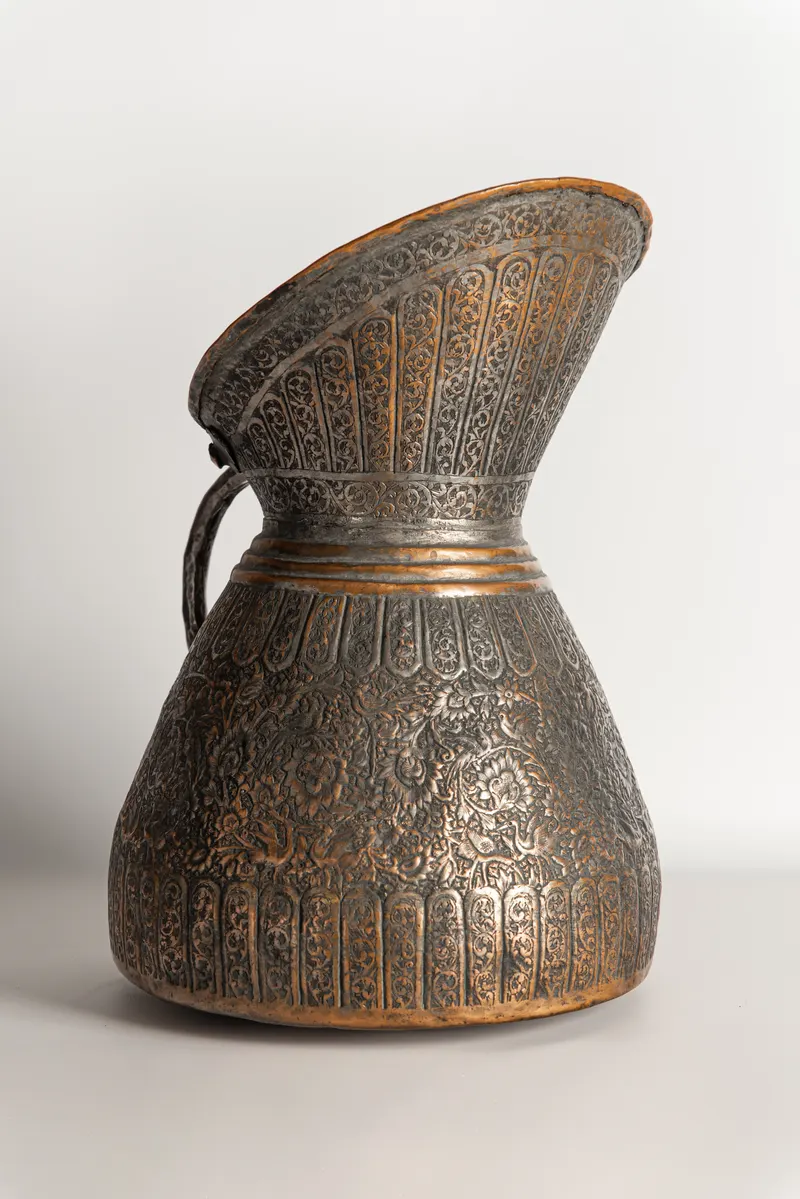
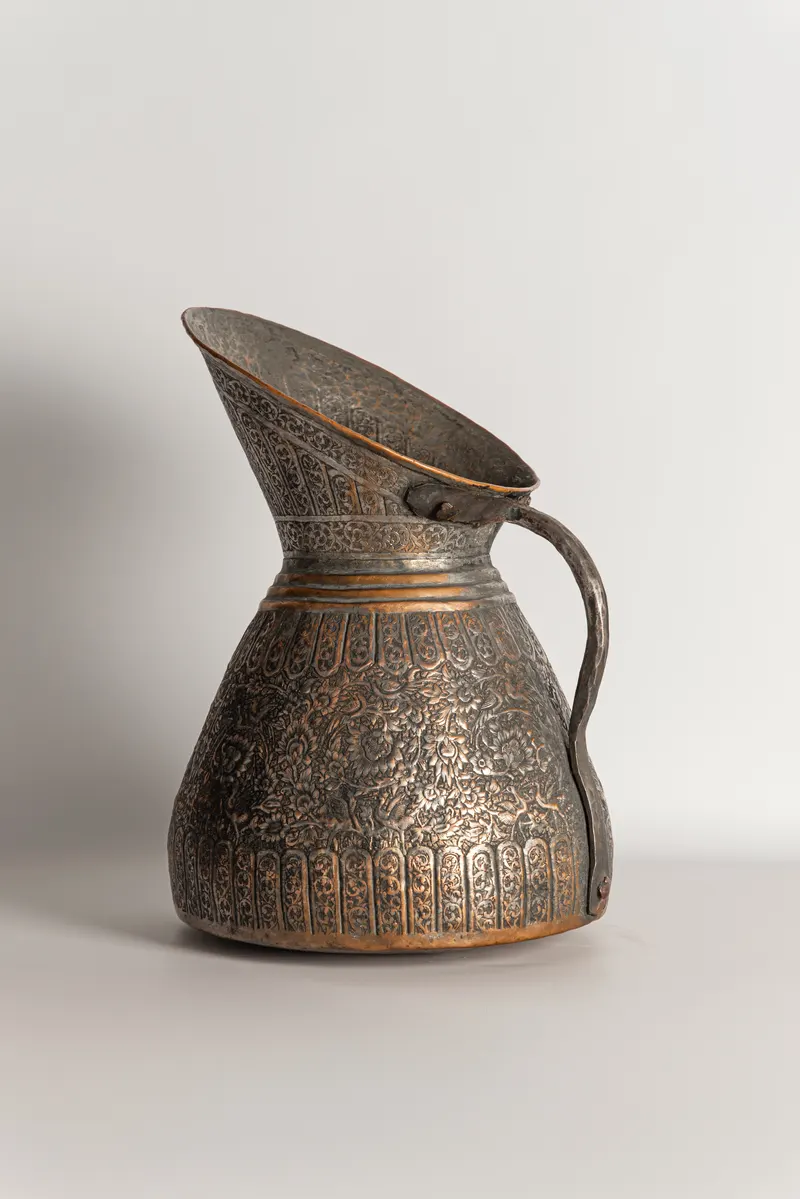
Persian art in the Felice Maffei Collection
This group of Persian art covers two periods of Iranian history. Felice Maffei acquired all six works in Iran in 1968. Three are Safavid and date from the 17th century. The other three date from the 19th century: two engraved copper pieces made in Isfahan and a lacquered mirror case of the Qajar period. All six belong to the Objects of Presence category.
Safavid art and metalwork
The Safavid dynasty ruled Iran from 1501 to 1736. In 1598 Shah 'Abbas, who reigned from 1587 to 1629, made Isfahan his new capital.
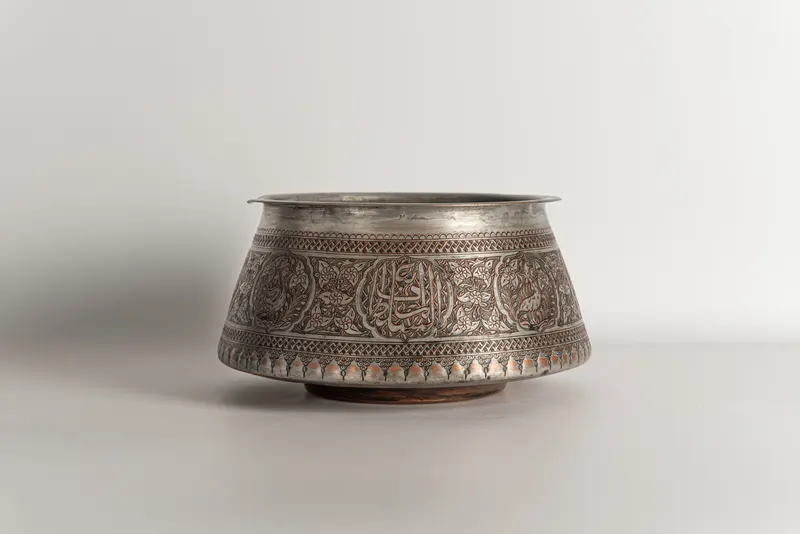
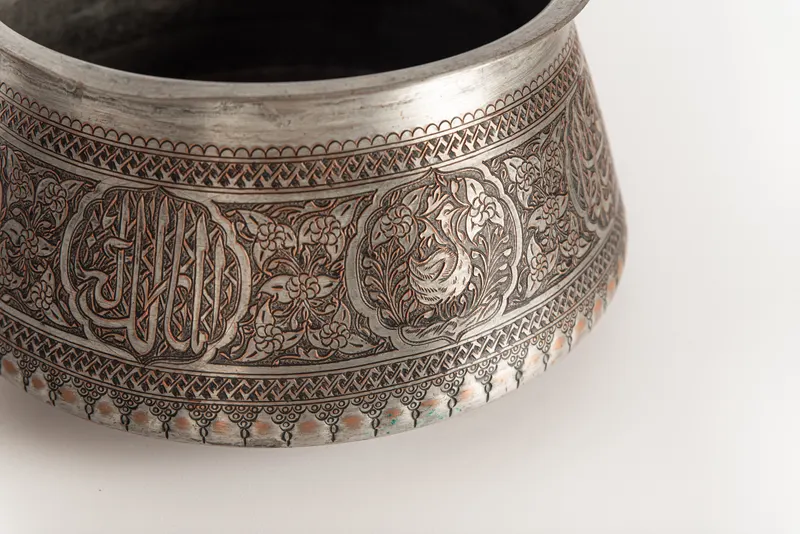
The three Safavid works are tinned copper with engraved decoration. A coat of tin covers the copper body, and where it has worn through, at shoulder bands, rims and raised lines, the copper shows beneath. The Safavid Pitcher Jug and the Safavid Pitcher Jug with Flared Neck each carry a central frieze of floral scrollwork with birds among the foliage, set between interlace bands and vertical lobed or fluted panels. On the Safavid Calligraphic Bowl, cartouches of cursive inscription alternate with medallions, each holding a bird in profile.
Museums hold Safavid metalwork of this kind. The Victoria and Albert Museum in London has a 17th-century bowl from Safavid Iran, catalogued as tinned copper with engraved decoration against a cross-hatched background.
Persian metalwork from Isfahan
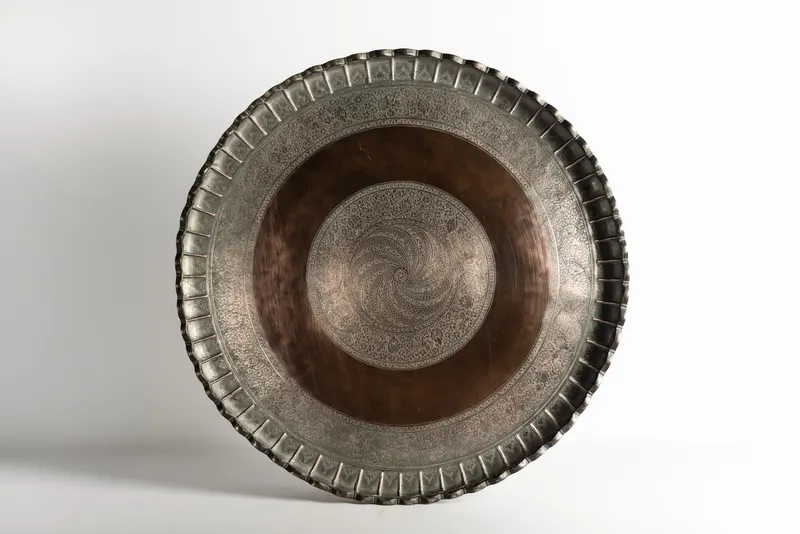
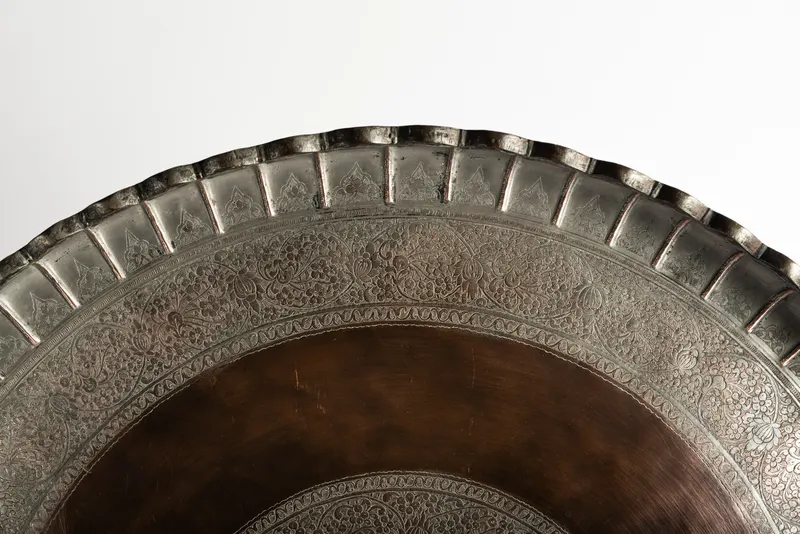
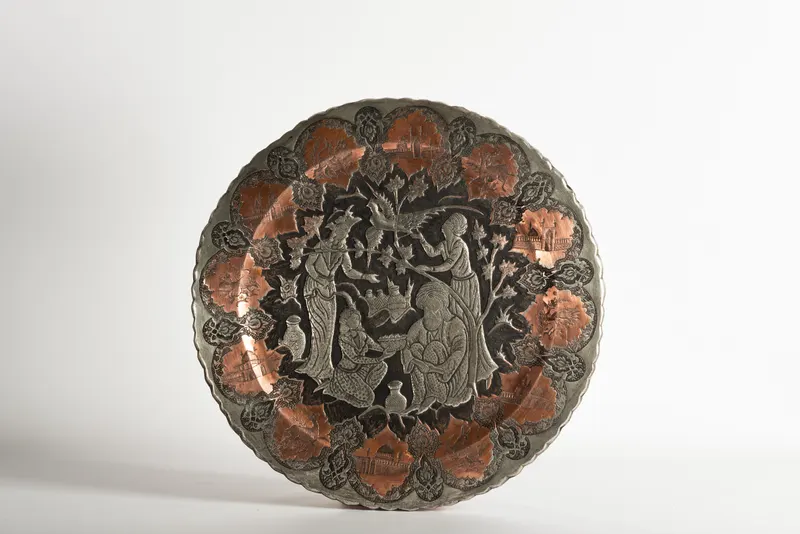
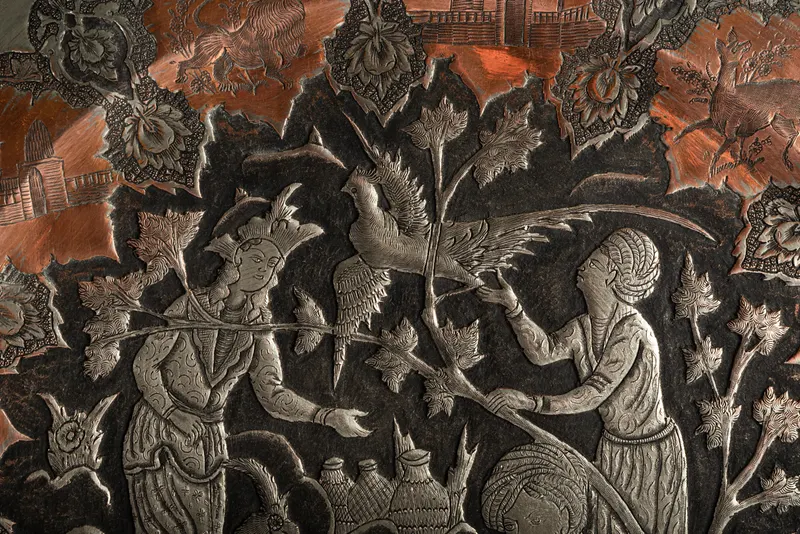
The Persian Ceremonial Tray and the Persian Figural Plate are 19th-century Persian metalwork, both made in Isfahan. The tray, 72.5 cm across, is tinned copper engraved in concentric registers of floral scrollwork around a central spiral, with a rim of lobed panels. The plate is engraved and patinated copper. At its centre four figures gather beneath a flowering tree, two reaching toward a bird in the branches and two exchanging a bowl of fruit. The border alternates engraved animals, a lion, a deer or a rabbit, with walled buildings and domed pavilions.
Qajar art and lacquer
The Qajar dynasty established its power in the 1790s and ruled Iran until 1925. According to the Victoria and Albert Museum, the production of lacquer objects in Iran peaked in the 19th century under the Qajars, and artists in Shiraz, Isfahan and Tehran continued to make fine work. Lacquer objects were built of papier-mâché and sometimes wood, decorated with small paintings and then varnished, which protected the painting and gave it a reflective surface. Mirror cases with closing covers came into use in Iran from the 1660s, when mirror glass was first imported from Europe.
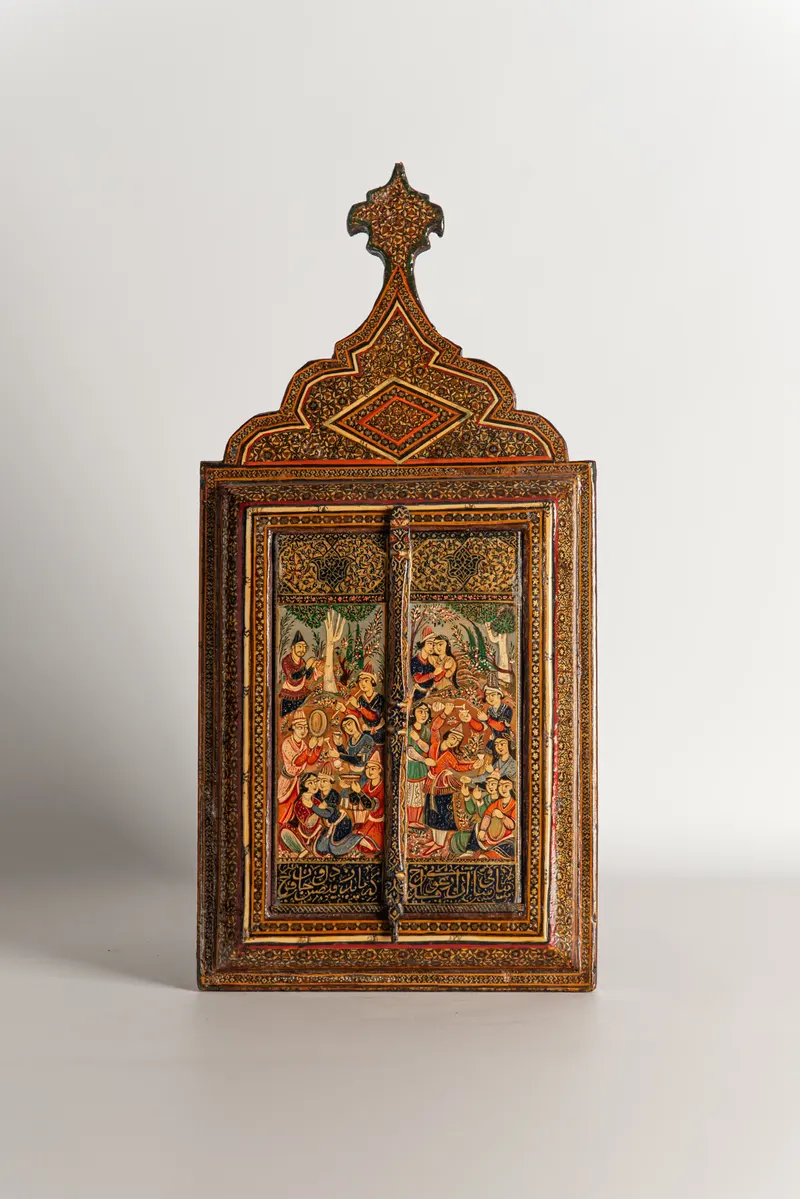
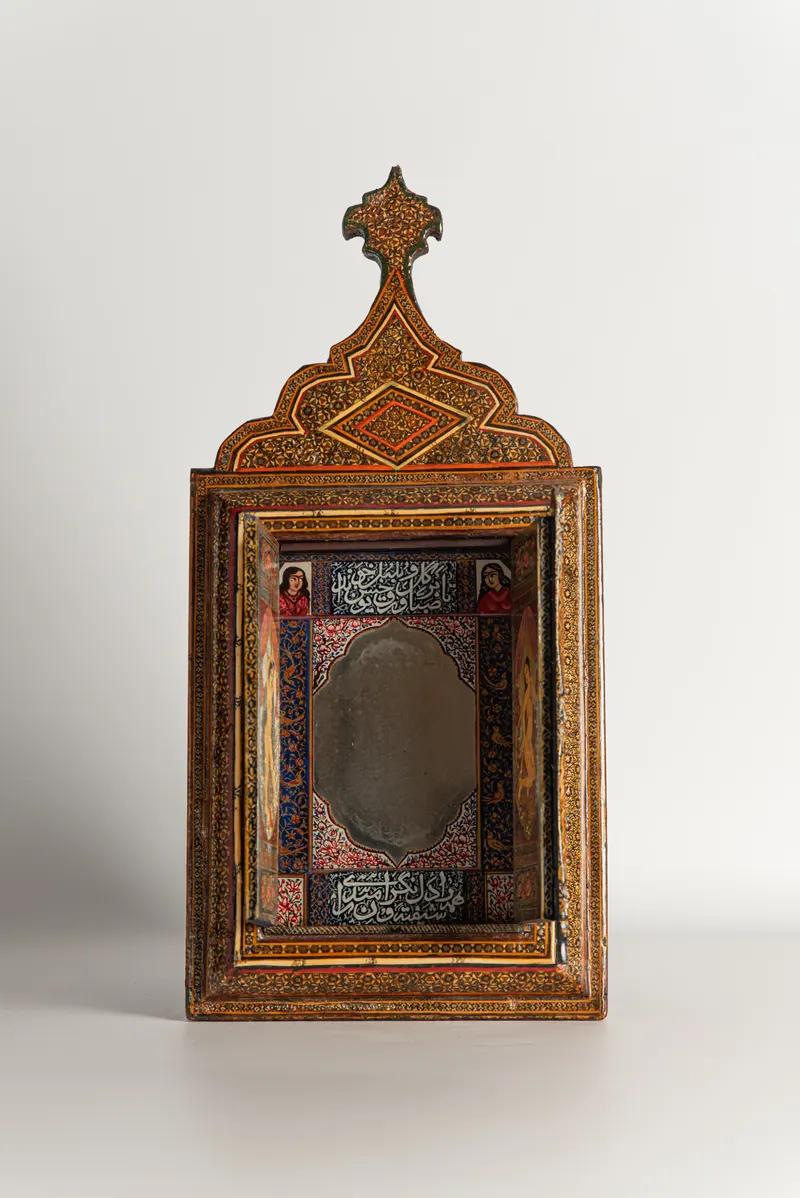
The Qajar Mirror Case is wood, lacquered and painted. Its two hinged doors form one scene of figures in a wooded setting exchanging vessels, above a band of calligraphy. Inside, a lobed mirror plate sits within a floral-vine border, with two painted bust portraits of a woman at the upper corners. The silvering of the mirror has clouded.